

Case Study: Engineering High-Volume Magnetic Uniformity for Advanced Thermal Processing

The Challenge: Scaling Precision in Custom Dipole Magnet Design
A leading manufacturer in the thermal processing industry approached our team with a critical problem. They required a high-precision, large-scale dipole magnet structure optimized for the vacuum annealing of thin-film magnetic read/write heads used in hard disk drives (HDDs).
While our engineering team possesses deep historical expertise in magnetic circuit design, this specific project pushed the boundaries of both scale and precision physics.
Unprecedented Volume Scaling: The client needed to establish a highly uniform magnetic field within a massive 8x8-inch area, standing 8-10 inches high. To put that in perspective, this is a volume equivalent to the interior of a small safe. For comparison, at the time, standard industry field sizes typically maxed out in the 1-to-2-inch square range.
Stringent Homogeneity Requirements: Most legacy industry benchmarks, including our own past compact disk dipole projects, focused merely on hitting a minimum magnetic field strength threshold (e.g., >1000 Gauss). This project demanded a tight, razor-thin target tolerance of +/- 30 Gauss across the entire expanded volume.
Strict Field Skew Limits: To prevent domain misalignment during the thermal process, the magnetic field could not deviate (skew) by more than 2° from the 0° reference in the field plane.
No permanent magnet manufacturer had previously attempted to hit these homogeneity and skew metrics along with a tightly targeted gauss window at this volumetric scale.
The Engineering Solution: Complex Geometry & Rigorous Validation
Achieving this level of spatial uniformity required moving beyond traditional, flat-pole piece dipole design. Our engineering team deployed advanced Finite Element Analysis (FEA) to model and mitigate the complex magnetic fringing effects inherent in large gaps.
Advanced Magnetic Simulation & Polynomial Optimization
Using FEA modeling, we designed a custom "dish-shaped" pole piece featuring a complex peripheral rim. This rim was strategically engineered to capture and redirect flux emanating from the edges back toward the center of the working volume.
To eliminate field distortion entirely, we mapped the rim's curvature using a precise polynomial equation. Through iterative FEA simulations, our team determined that incorporating a term raised to the fourth power yielded the highest degree of magnetic field homogeneity. The curve follows this mathematical form:
y = a + bx² + cx⁴
By utilizing this specific fourth-power progression, the forward curvature increased as it extended outwardly, effectively flattening the magnetic field across the massive 3D volume.

Manufacturing Constraints & Zero-Defect QA
Engineering the physics was only half the battle; we also had to work around fixed physical constraints and invent new validation protocols:
Space Constraints: The entire custom magnet assembly had to retroactively fit within the exact footprint and gap restrictions of the client's existing, operational thermal processing oven.
Component-Level Quality Assurance: Because the final assembly could not be fully tested for total uniformity until completely built, we executed a strict "zero-defect" manufacturing flow. Before assembly, we mapped the demagnetization curves of all raw magnetic blocks. Post-fabrication, every individual magnet underwent rigorous testing using Helmholtz coils to verify magnetic moment uniformity.
In-House 3-Axis Probing: We engineered specialized, custom 3-axis probing fixtures to validate the complete magnetic circuit in-house, ensuring the physical assembly perfectly mirrored our digital simulations before shipping.
The Result: Precision That Defied Expectations (and a US Patent)
Our engineering team managed the final integration and calibration directly over the client's thermal processing oven inside their cleanroom. To verify the magnetic field under real-world operating conditions, we deployed a custom-built test harness.
The resulting uniformity was so precise it actually triggered immediate skepticism from the client's quality assurance team:
Engineering Anecdote: During the initial validation phase, the field homogeneity and angular accuracy metrics came back so perfectly flat that the client's lead engineer assumed our sensors were broken or frozen. To prove the system's validity, our team had to manually move the probe entirely outside the pole assembly to demonstrate that the gaussmeter was active, calibrated, and accurately capturing data.
Technical Performance Summary
The final manufactured assembly didn't just meet the client's aggressive tolerances; it significantly outperformed them on the very first iteration.
Metric | Client Requirement | Actual Achieved Performance |
Working Field Volume | 8x8x10 | 8x8x10 |
Field Homogeneity | +/- 30 Gauss | +/- 7 Gauss (Exceeded by 4x) |
Angular Field Skew | 2° | 0.75° (Exceeded by 2.5x) |
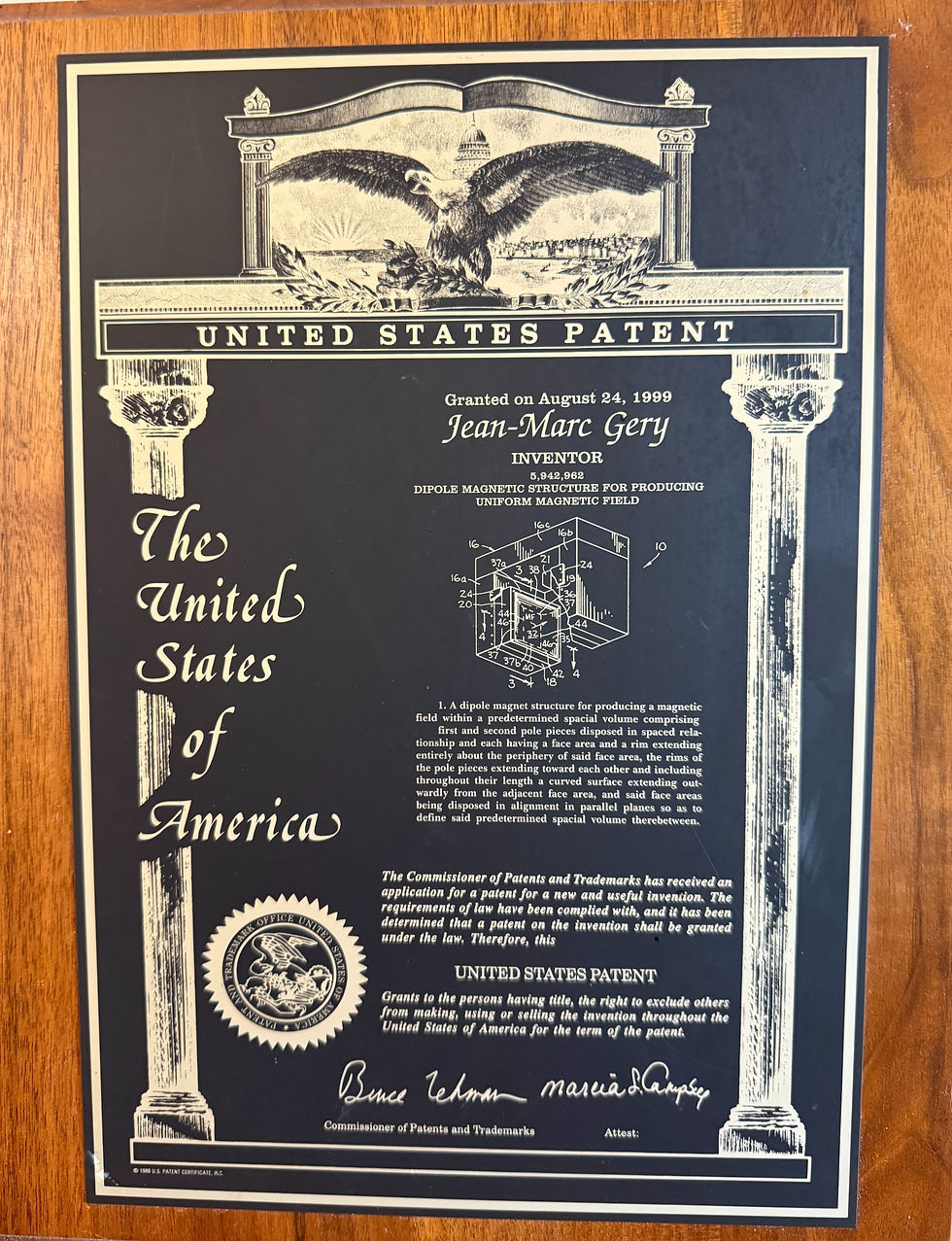
By achieving perfect domain alignment on the first pass, the client avoided costly manufacturing downtime and secured an optimized yield for their thin-film read/write heads. Furthermore, the novel geometry engineered for this project was granted a proprietary patent (US Patent 5,942,962), cementing this design as a benchmark in industrial magnetics.
Partner with Custom Magnetics Experts
This case study proves that massive scale and extreme magnetic precision do not have to be mutually exclusive. Whether your application demands strict magnetic field homogeneity, tight field skew constraints, or complex environmental engineering for thermal processing, our team specializes in turning theoretical physics into high-performance industrial realities.
Ready to optimize your magnetic circuit? Contact our engineering team today to discuss your custom dipole requirements.


