

Case Study: Mitigating Hydrogen Decrepitation in Robotic Assembly
- Ron Zichterman
- 5 days ago
- 2 min read

The Challenge: Material Failure in Volatile Environments
A leading equipment manufacturer faced critical component failure in their robotic assembly arms. The introduction of a new hydrogen-based processing gas caused Hydrogen Decrepitation in the standard Neodymium (NdFeB) permanent magnet rotors.
Hydrogen atoms infiltrate the NdFeB crystal lattice, causing the material to expand and eventually crumble into a fine, demagnetized powder. The client required a solution that met three non-negotiable constraints:
Hermetic Isolation: The magnets must be shielded from hydrogen exposure.
Form-Factor Parity: The new assembly had to be a "plug-and-play" replacement within the existing mechanical footprint.
Flux Performance: The assembly had to maintain or exceed original torque/strength despite the added thickness of a protective encasement which decreased the volume available for the magnets and increased the effective magnetic air gap to the stator.
The Engineering Solution: FEA-Driven Redesign
Our solution architecture followed a dual-path engineering strategy: optimizing the magnetic field through Finite Element Analysis (FEA) while simultaneously developing a low-thermal-impact manufacturing process. This ensured that the transition to a hermetically sealed design did not compromise the rotor’s original torque-to-volume ratio.
Magnetic Circuit Optimization
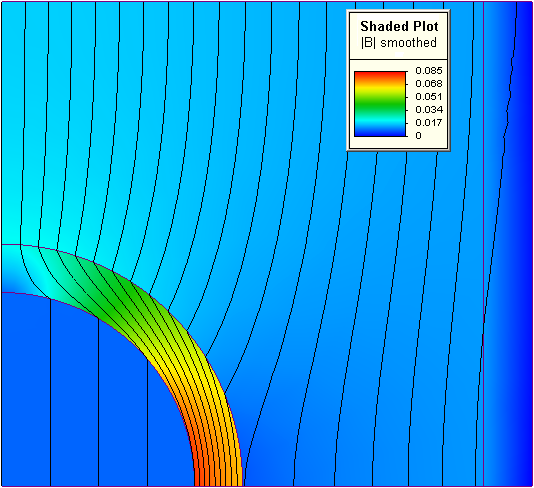
The addition of a stainless steel hermetic sleeve significantly increased the magnetic air gap, increasing the overall reluctance of the system. To compensate for the resulting flux loss, we utilized FEA to model the magnetic field.
Material Upgrade: We transitioned to a high-remanence, high-coercivity grade of NdFeB.
Performance Simulation: We simulated the motor’s back-EMF and sine wave patterns to ensure the new rotor maintained a smooth torque profile without introducing harmonic distortion.
Advanced Manufacturing and Hermetic Sealing
The primary challenge in hermetic sealing is the heat at the weld joint. Conventional welding can reach the Curie Temperature ( Tc ) of the magnet, causing permanent loss of magnetic properties.
Precision Laser Welding: We worked with our laser welding partner to design a welding process that would allow a deep-penetration weld on the stainless steel enclosure without affecting the magnetic integrity of the internal rotor.
Validation: Every unit underwent a rigorous QA protocol to guarantee a true hermetic seal before deployment. This involved a Helium Standard leak test in vacuum that emulated the process vacuum in which the robotic arm operated.
The Results: Zero Failures, Maximum ROI
By re-engineering the component rather than the system, we provided the client with a solution that was technically superior and fiscally responsible.
Reliability: Zero reported failures after thousands of deployments.
Cost avoidance: Saved the client the multi-million dollar expense of a full robotic arm redesign and subsequent lengthy re-qualification period.
Interchangeability: The new rotors dropped directly into the existing robotic arms with no software or mechanical adjustments required.
Partner with Magnetics Experts
Whether you are dealing with extreme temperatures, corrosive gases, or space constraints, our engineering team specializes in making the "impossible" magnetic circuit a reality. Contact us to learn more!
